Saturday, April 30, 2011

Brewers' 2 Hole: The Gomez Problem

Well, it's May 1st, and with one month of the season gone the Brewers are, as (we should have) expected, languishing with an NL Mediocre division-defining 13-13 record. We've been asked to be patient: for the lineup to get back in tact (it is), for the pitching staff to get back in tact (Zack Greinke returns Wednesday) and for new manager Ron Roenicke to get a feel for his players, what their strengths are, and how to most effectively use them.

It is with this third point that we have become increasingly impatient. With one sixth of the season gone, it is now time for Ron to get over the getting-to-know-you phase and start managing his lineup in a more effective way. Yes, we know that we've just recently finally gotten Corey Hart back, and that the ace of the staff has yet to make his 2011 debut, but this team has too much talent and, more importantly, too much invested in this one year to be content with a 13-13 record entering May.

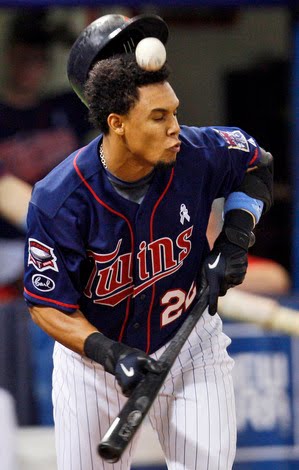
The most frustrating change that hasn't yet been made is Roenicke's stubborn refusal to use anyone other than the mercurial Carlos Gomez in the important second spot in the lineup. Even without stats, even the most casual Brewers fan who has watched games this year can tell you that even though Gomez has shown flashes of compentence (see the Brewers' first series against the woeful Astros, whom the Brewers are, as I write this, threatening to lose another series to), he often makes up for the occasional lapse in terrible-ness by being picked off of first, running his teammate off the bases, or getting thrown out trying to stretch a double into a triple.

But complaining about a problem means nothing if you don't present your own alternatives. So here, with statistical analysis to back it up, are three alternatives, three of which even allow Roenicke to keep his pet in the lineup.

1) Jonathan Lucroy at 2, Carlos Gomez to 8
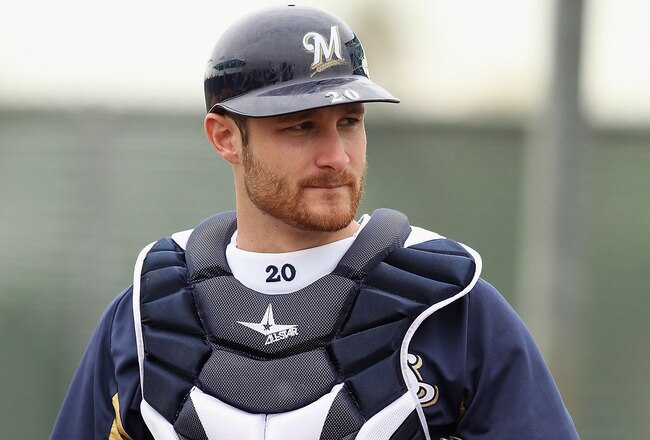
Lucroy has only been back for a couple weeks, but he already looks to be in mid-season form, hitting .333 with a .400 on-base percentage through 12 games. Lucroy appears to be enjoying something like the opposite of a sophomore slump in his second season as the Brewers' primary catcher, and appears to be forcing his manager to consider moving him up out of the 8th spot of the lineup.

One of the drawbacks to this option is that Lucroy can't play every day, and as we've seen (anyone remember Ned Yost stubbornly insisting that the left fielder always batted third, even if that meant slotting Laynce Nix in the lineup's most important spot?), major league managers are loathe to make any major changes to their lineups on a regular basis. The fragile egos of these 20-40 year old men just can't handle that kind of stress, I guess. However, even if Roenicke were to hit his catcher second, regardless of who's name he was penciling onto the lineup card, it would be a huge boost over what Gomez has provided at the 2 spot. Here's the production from the 2 hole, where Gomez has started a majority of the team's games, and the 8th spot, which has been occupied by the catcher in almost every game this season:

2nd: .250 BA, .291 OBP, 2 HR, 11 RBI, 6 SB
8th: .297 BA, .369 OBP, 2 HR, 9 RBI, 0 SB

The Brewers would lose the threat of the stolen base in this scenario, but the nearly 80 points of on base percentage gained would more than make up for Lucroy's lack of aggressiveness on the basepaths.

2) Corey Hart
This is the most obvious alternative, and one that may yet be the plan after Corey has had time to settle in, but my patience with The Gomez Problem has run out, and I refuse to wait another day. We already know what Corey can do, as he hit 31 HR and was an All-Star starter last year hitting in the 2 hole. Here's last year's production from that spot last year, to compare to this year's (keep in mind, these stats are from a full year, while this year's were from only 26 games):

2nd: .268 BA, .314 OBP, 19 HR, 83 RBI

Also keep in mind that these stats have been brought down by the fact that Hart shared this spot with Gomez in 26 games last season.

3) Nyjer Morgan
Obviously, Morgan is currently on the 15-day disabled list, and if he has remained healthy, perhaps he would have already supplanted Gomez as the starting center fielder and the guy at the 2nd spot. But Morgan was hitting .455 with a .500 on base percentage before his injury.

With the Brewers now under .500 as I conclude writing this, the time to make these changes needs to be now, before they slowly, quietly slide out of the race.

Wednesday, April 27, 2011

What to do with Grienke?

The Brewers have done what we said they needed to do, which was tread water until the stars that began the year on the DL (Zack Greinke, Corey Hart, Jonathan Lucroy) were back and ready to lead us to the promised land. Pending the result of today's game, which doesn't look promising at the moment, the Brewers are right at .500 and, more importantly, within a game of first place in the NL Mediocre. There's plenty to complain about: disappointing starts from John Axford and Sean Greene, the lack of production from the bottom of the order, Ed Cedar's terrible decision making, but there's also plenty to rave about for the Crew: an MVP type start for Ryan Braun to go with All-Star starts from Prince Fielder and Rickie Weeks and a very surprising start to the season for the starting rotation.

Which brings us to Greinke, who will likely make just one or two more rehab starts with Triple A Nashville before making his Brewers debut in early May. The Brewers starting rotation has been flipped upside down, and if the trends started in April continue into May, then Ron Roenicke and the Brewers front office is going to have an interesting decision to make.

To start, here's a look at the Brewers starting rotation, top to bottom, this year (stats through April 26):

Yovani Gallardo: 2-1, 4.88 ERA, 31.1 IP, 20 K
Shawn Marcum: 2-1, 2.73 ERA, 29.2 IP, 28 K
Randy Wolf: 3-2, 2.64 ERA, 30.2 IP, 29 K
Chris Narveson: 1-1, 4.33 ERA, 27 IP, 25 K
Marco Estrada: 1-0, 3.00 ERA, 21 IP, 18 K

So, as expected, Wolf and Marcum are the clear aces of the staff, with Estrada and Narveson being the solid middle-of-the-rotation guys we thought they'd be, and Gallardo filling in temporarily until Greinke is ready to...wait a minute, what? Before the season it was clear that Estrada would make his way back to Nashville promptly when Greinke was ready to return, and the dominating threesome of Greinke, Gallardo and Marcum would lead us to 90 wins and an NL Mediocre title. But now, with the starting rotation looking like it just came out of a blender, the picture is no longer so clear.

So now what? It's clear at this point that Estrada has pitched himself into a guaranteed spot on the Brewers' roster, though its unlikely to be as a starter: no one other than Gallardo has really pitched himself out of the rotation, and there's no way on Yount's green earth Yo leaves the rotation, barring a convenient DL stint for him when Greinke returns. So no, there will not be any question about what the rotation will look like: Greinke, Gallardo, Marcum, Wolf and Narveson will be the Crew's rotation, as expected.

The decision making will come from who the crew will send down from the bullpen, especially with Takashi Saito set to return from the DL at about the same time. Here are the candidates:

Green: 7.27 ERA, 8.2 IP, 3 K
Brandon Kintzler: 4.22 ERA, 10.2 IP, 13 K
Zach Braddock: 2.16 ERA, 8.1 IP, 6 K

Braddock should be safe, so it should be Green out the door first followed by Kintzler. That being said, however, Green is an established major league player whom the Brewers traded for in the offseason, and the Brewers have in the past resisted dispatching with those type of guys despite their performance. It's difficult to imagine him surviving Greinke's return, however: he's been by far the worst of an otherwise solid bullpen, with another run surrendered today as I write this.

But how much impact will Greinke's return really have? The Brewers are 2-1 in Estrada's starts this year, and the loss was in Washington, when the Brewers' bats appeared to have been lost by baggage claim. On the whole, does Greinke give the Brewers a better chance to win than Estrada does? Sure. But the real impact will come in the strengthening of the bullpen...and in Gallardo bouncing back, which he surely will soon.

Saturday, April 9, 2011

MLB Preview Part 7: Playoffs and Awards

ALDS

Boston Red Sox (East) over Minnesota Twins (Wild Card)

Chicago White Sox (Central) over Texas Rangers (West)

NLDS

Philadelphia Phillies (East) over Milwaukee Brewers (Central)

Los Angeles Dodgers (West) over Atlanta Braves (Wild Card)

ALCS

Boston Red Sox over Chicago White Sox

NLCS

Philadelphia Phillies over Los Angeles Dodgers

World Series

Philadelphia Phillies over Boston Red Sox


Awards

American League

Most Valuable Player – Adrian Gonzalez, 1B, Red Sox

Cy Young – David Price, LHP, Rays

Rookie of the Year -- Jeremy Hellickson, RHP, Rays

Manager of the Year – Brett Gardenhire, Twins

Comeback Player of the Year – Jake Peavy, RHP, White Sox

National League

Most Valuable Player – Ryan Braun, RF, Brewers

Cy Young – Clayton Kershaw, LHP, Dodgers

Rookie of the Year– Aroldis Chapman, LHP, Reds

Manager of the Year– Don Mattingly, Dodgers

Comeback Player of the Year – Nate McClouth, OF, Braves

Tuesday, April 5, 2011

MLB Preview Part 6: AL West

Is this almost too late to be relevant? Yes. Am I going to do it anyway because I can't not finish something I started? Yes. Is the fact that the Brewers once promising season has become a horrific train-wreck excuse enough for me to not really want to write about baseball so much? I think so. Did I forget to post this four days ago? Absolutely. Anyway, here's part six, the AL West.

1) Texas Rangers
What to like: The defending American League champions got off to a hot start by sweeping the league favorite Red Sox. The potent lineup, led by a pair of MVP candidates in the outfield in Josh Hamilton and Nelson Cruz, got even stronger in the off-season when the Rangers added 3B Adrian Beltre, whose outstanding season last year earned him a huge contract. The tenuous situation with utility player Michael Young, who is an important part of the Texas lineup, seems to have calmed down some.

What not to like: Losing staff ace Cliff Lee is going to have an impact on the Rangers. The only real outside help they got to replace Lee is RHP Brandon Webb, who hasn't been healthy in years and still isn't ready to start making minor league starts. The starting rotation will only be good enough to help the Rangers repeat as AL West champions if most or all of last years surprises (Colby Lewis, C.J. Wilson, Tommy Hunter) turn out to not be flukes.

Outlook: If the pitching holds up, and it says here that it will, the Rangers should have no problem winning around 90 games and repeating as division champions.

Key player: Hamilton. The reigning AL MVP is one of the great baseball stories of the past decade, sealing his successful comeback with his record-setting performance in the 2009 home run derby and then putting a stamp on it with his terrific season last year. Hamilton is in the driver's seat for the Rangers on offense, so they'll go as far as he can take them.

X-factor: Cruz. Cruz has been extremely impressive for the Rangers, considering he was a throw-in in the deal that brought slugger Carlos Lee to Texas in July of 2006 (nice work, Milwaukee). However, he is quickly approaching "injury-prone" status, as he has to play in 130 games in a season. If he can stay healthy, he'll team with Hamilton to give the Rangers one of the league's best 1-2 punches in the middle of the lineup.

Notable additions: Beltre, Webb, C Mike Napoli, LHP Arthur Rhodes

Notable subtractions: Lee, C Bengie Molina, DH Vladimir Guerrero

2) Oakland Athletics
What to like: Oakland's starting pitching staff is filled with guys who are the best pitchers you've never heard of: the A's starting staff led the league with a 3.47 ERA, yet most casual fans would struggle to name even one member of Oakland's starting rotation. The most notable member of the rotation, last year's perfectionist Dallas Braden, is probably only the fourth best pitcher on the team, behind Trevor Cahill, Brett Anderson and Gio Gonzalez. The offense added a couple of live bats in the off-season in outfielders David DeJesus and Josh Willingham and DH Hideki Matsui.

What not to like: The oft-injured Rich Harden, whom the A's brought back this off-season, is again on the DL, along with closer Andrew Bailey. Outside the three aforementioned acquisitions, there's not a lot of punch in the Athletics' lineup, which ranked 23rd in runs scored last year.

Outlook: The Athletics are talented, especially at the pitching position, and should be competitive in the division all season. Their lineup, however, is likely not strong enough to get them over the hump to unseat the Rangers in the West.

Key player: Cahill. The A's Opening Day starter saw his ERA drop over a point and a half from his 2009 rookie season, and made the All-Star team as a result. He was solid in the A's Opening Day loss to Seattle, striking out eight and surrendering just one run in 4.2 innings. He'll be expected to continue to progress into a top of the line ace for Oakland this year.

X-factor: Kurt Suzuki, C. Oakland's young catcher has been an iron man behind the plate, appearing in an average of 142 games in the last three seasons. He posted a career low .242 batting average last year after two consecutive years of .270 plus, however, and the A's need him to rebound this year and help anchor their lineup.

Notable additions: DeJesus, Willingham, Matsui, Harden

Notable subtractions: OF Rajai Davis, OF Jack Cust, RHP Ben Sheets

3) Los Angeles Angels of Anaheim
What to like: The top of the rotation features the best 1-2 punch in the division in righties Jered Weaver and Dan Haren, each of whom posted ERAs of around 3 while playing for the Angels last season. The addition of OF Vernon Wells was panned by critics due to the size of his contract (and his belt line), but the money they're paying him shouldn't impact his on-field play, and he makes the lineup better.

What not to like: RHP Scott Kazmir continues his alarming slide into irrelevancy: the two-time All-Star saw his ERA rise over a point last year to 5.94, a far cry from his sub-3.50 days with the Rays. Slugging 1B Kendrys Morales, who injured his knee celebrating a walk-off grand slam last season, still hasn't returned and could be out until mid-May. The lineup is average, which isn't good enough for a team looking to contend with the Rangers and Athletics.

Outlook: Barring a very fast start and a blockbuster midseason deal to acquire more talent, the Angels will likely be also-rans in an improving American League West, a division they dominated from 2006-09.

Key player: Weaver. The Angels ace posted a 3.01 ERA and led the American League in strikeouts last season which put him squarely in the Cy Young race. Poor run support from the lineup saddled him with 12 losses, however. He may need to be even better than he was last year to keep the Angels above .500 this season.

X-factor: Peter Bourjos, CF. Veteran Torii Hunter moves to right to make room for the speedy rookie, who hit .314 and stole 27 bases last year at AAA Salt Lake. His stellar defense continues the tradition that Hunter and Jim Edmonds have set in center, but it remains to be seen if his bat can match those of his predecessors.

Notable additions: Wells

Notable subtractions: C Mike Napoli, DH Hideki Matsui

4) Seattle Mariners
What to like: Seattle's two superstars, OF Ichiro Suzuki and RHP Felix Hernandez, are back to chase down individual goals (Ichiro's 11th straight 200 hit year, Hernandez's second straight Cy Young award) and give the fans something to cheer about.

What not to like: King Feliz can't pitch every day, and Ichiro's season hit total might be greater than the rest of the lineup combined. An offense that produced just 3.2 runs per game last season made little improvement in the off-season, with only mild upgrades at first base, catcher and designated hitter.

Outlook: Hernandez will dominate, Ichiro will continue his march towards 3000 hits, and the Mariners will lose 100 games.

Key player: Hernandez. King Felix shattered the record for the lowest number of wins by a Cy Young award winner, thanks in large part to a Mariners offense that scored two or fewer runs in nearly half of his starts. He gave up more than 3 earned runs just four times last season, and failed to finish at least 6 innings just twice. Unfortunately, none of it matters until the Mariners have an offense that can score runs.

X-factor: Justin Smoak, 1B. Smoak was one of the most highly coveted talents in the 2008 draft, but he disappointed in his rookie season for the Rangers, hitting just .209 with eight home runs in 100 games before being shipped to Seattle in the Cliff Lee trade. He wasn't much better in his 70 appearances as a Mariner, hitting .239 with five home runs. He's only 24 years old, however, so there's plenty of time to develop into the slugger scouts expected him to be.

Notable additions: C Miguel Olivo, DH Jack Cust

Notable subtractions: 1B Russell Branyan

Friday, April 1, 2011

MLB Preview Part 5: NL West

I meant to wrap these up on Opening Day, but the Brewers’ catastrophic 9th inning debacle in Cincinnati turned me off to baseball for about 24 hours. So here we go, two days late but still wonderfully relevant: the NL West.

1) Los Angeles Dodgers
What to like: The starting rotation isn’t flashy, but its solid from top to bottom: Clayton Kershaw is a top of the line ace, and newly acquired Jon Garland is probably the best No. 5 pitcher in the league. Each is capable of a sub-4.00 ERA and double digit wins. The heart of the order, featuring OF Matt Kemp, OF Andre Ethier, 1B James Loney and SS Rafael Furcal, is easily the best in the division, if they can stay healthy. C Rod Barajas and 2B Juan Uribe should be upgrades over Russell Martin and Ronnie Belliard.

What not to like: The only real question mark is the bullpen. Closer Jonathan Broxton was a star in 2009, but saw some regression last year, despite making the All-Star game for the second consecutive year. The lineup failed to produce consistently throughout the season last year, and the stars will have to bounce back for the Dodgers to win.

Outlook: If the lineup can produce, and everyone stays healthy, the Dodgers have the kind of roster that can unseat the Giants as NL West champions. The starting rotation is deep enough to keep the Dodgers in games on a daily basis.

Key player: Kershaw. The Dodgers’ ace was terrific on Opening Day, outdueling headliner Tim Lincecum and sending a message to the Giants early. If he can maintain at that level throughout the season, he has the potential to win 18-20 games and compete for a Cy Young award.

X-factor: Furcal. The Dodgers shortstop is terrific when healthy: he’s always a threat to hit .300 and steal 25 bases. However, he’s played a full season only once since 2008, and his All-Star campaign last year was marred by injuries, as he played only 97 games. The Dodgers need him to stay healthy and produce all season.

Notable additions: Garland, Uribe

Notable subtractions: Martin

2) San Francisco Giants
What to like: I don’t really like forecasting repeat division winners in most cases, but the World Champions are solid up and down and should only improve in 2011. The offense should improve with a full season of NL Rookie of the Year Buster Posey, a bounce-back year from Pablo Sandoval and a renovated outfield. And of course, the rotation, led by Tim Lincecum and Matt Cain, is still the best staff west of Philadelphia.

What not to like: The Giants don’t score a ton of runs, and while they should be better, they still won’t be lighting up the scoreboard. There’s also an overwhelming sense that they just happened to get hot at the right time last year, and probably weren’t baseball’s best team.

Outlook: I don’t see a return trip to the fall classic for the Giants, but back-to-back division titles is possible as long as the offense can put up at least a couple runs per game.

Key Player: Posey, C. His numbers from his rookie season, in which he had just 403 at bats, extrapolate to about 25 HR, 100 RBI and a .300 batting average over a full season. Assuming he improves with experience, Posey is a sure-fire multiple All-Star and a possible MVP candidate. He’ll be expected to lead an otherwise pedestrian Giants offense.

X-factor: Jonathan Sanchez, RHP. Sanchez’s ERA in 2010 (3.07) was over a point lower than his previous career best the year before (4.24). It could be that he’s finally fulfilling the potential he showed in the minors, or it could be that he just had a career year and his ERA will normalize to about the 4.50 mark he’d shown during the first four years of his career. Control is an issue: he lead the NL in walks last year.

Notable additions: SS Miguel Tejada

Notable subtractions: INF Juan Uribe, SS Edgar Renteria

3) Colorado Rockies
What to like: The Rockies offense, which is lead by a pair of MVP candidates in SS Troy Tulowitzki and OF Carlos Gonzalez, with the former looking to solidify his standing as the league’s best shortstop and the latter looking to prove that his breakout year in 2011 wasn’t a fluke. Cy Young candidate Ubaldo Jimenez is one of the game’s best pitchers.

What not to like: Gonzalez’s 2010 might have been a fluke, and other than Tulowitzki, a lot of players are going to need to have bounce-back years for the Rockies to contend for a division title: 1B Todd Helton and C Chris Ianetta chief among them. The rotation behind Jimenez is precarious at best, with Jorge De La Rosa and Jhoulys Chacin the best options behind the ace.

Outlook: The Rockies could easily steal the division title from the Giants should the defending world champs stumble, and if they can learn to win games on the road.

Key player: Gonzalez. The Rockies’ young outfielder came out of nowhere to win the NL batting title (.336) while tallying 34 HR, 117 RBI 26 SB and 197 hits, all of which were totals greater than his first two MLB seasons combined. If it wasn’t a fluke, then Gonzalez is a legitimate triple crown threat and should lead the Rockies into a battle for the division.

X-factor: De La Rosa. The Brewers and Royals castoff has found a home in the Rockies starting rotation as the team’s most consistent pitcher behind Jimenez. His career numbers aren’t great: a 5.02 ERA and a WHIP of 1.52, but he’s been improving steadily every year since 2007, and has progressed into a solid middle of the rotation guy.

Notable additions: UTIL Ty Wiggington

Notable subtractions: C Miguel Olivo, RHP Jeff Francis, RHP Octavio Dotel

4) San Diego Padres
What to like: Not a whole lot, other than the fact that the Diamondbacks should keep them out of the cellar. Outside of Mat Latos and Clayton Richard, the last holdovers from a depleted starting rotation, the Padres don’t have a lot to like.

What not to like: The team that surprised everyone to grab 90 wins and second place in the NL West was ransacked in the off-season, losing slugger Adrian Gonzalez as well as four other offensive starters and half of its starting rotation in the departures of Jon Garland, Kevin Correia and Chris Young. The replacement parts (RHP Aaron Harang, 1B Brad Hawpe), with the exceptions of Tampa Bay import SS Jason Bartlett and 2B Orlando Hudson, are significant downgrades.

Outlook: The Padres won’t be winning 90 games this season, and with all the losses they sustained, 90 losses isn’t out of the question.

Key player: Tim Sauffer, RHP. The Padres Opening Day starter has dealt with numerous injuries since being drafted fourth overall in 2003, but finally made his mark in the majors last year when he was inserted into the rotation during last season’s pennant race.

X-factor: Casey Kelly, RHP. The star pitching prospect was the key piece of the trade that sent Gonzalez to the Red Sox in the off-season. With little else to look forward to in San Diego, the hope is that Kelly pans out and makes the loss of their best offensive player more digestible.

Notable additions: Bartlett, Harang, Hawpe, Hudson, CF Cameron Maybin

Notable subtractions: Gonzalez, Garland, Young, Correia, CF Tony Gwynn Jr., 2B David Eckstein, SS Miguel Tejada, C Yorvit Torrealba,

5) Arizona Diamondbacks
What to like: See Padres, San Diego. RHP Daniel Hudson, who the Diamondbacks acquired from the White Sox last July in the Edwin Jackson trade, has the stuff to be a legitimate staff ace. 2B Kelly Johnson is talented, but he’ll never be the best hitter on a contending team. Slotting newly acquired RHP J.J. Putz in the closer role is … well, it’s better than anything else they had.

What not to like: Other than Hudson, the starting rotation, along with the rest of the pitching staff, is filled with mediocre-at-best talent. The lineup is weak, filled with several once-promising prospects that have largely disappointed like OF Justin Upton and SS Stephen Drew. They didn’t get nearly enough in return for departed stars Dan Haren and Mark Reynolds, so there’s not a lot of hope on the way in the farm system, either.

Outlook: Avoiding 100 losses would have to considered somewhat of a success for the D’Backs. If the Padres struggles get out of hand, maybe they can snag fourth place.

Key player: Hudson. The one slight glimmer of hope for the D’Backs was 7-1 with a 1.69 ERA in 11 starts with Arizona last season. If nothing else, Hudson guarantees that the Diamondbacks will be in a game at least once every five days, at least until the bullpen takes over.

X-factor: OF Chris Young. Young was the Diamondbacks’ representative at the All-Star game last season, probably more by default than anything else. Still, he hit 27 home runs and his .257 batting average, 91 RBI and 28 stolen bases were the highest totals of his four year career. He’ll need to get his average up to be a true anchor in the middle of the lineup, but the talent is there.

Notable additions: Putz, 1B Russell Branyan, LHP Zach Duke, OF Xavier Nady, 3B Melvin Mora, RHP Armando Gallaraga

Notable subtractions: 3B Mark Reynolds, RHP Brandon Webb, 1B Adam LaRoch